
How Long Does Betrayal Trauma Last?

If you've recently discovered an affair, you may be wondering:
"How long am I going to feel like this?"
Maybe you're crying every day. Maybe you can't eat. Maybe you can't sleep. Maybe your mind keeps replaying what happened over and over, even when you're desperate for it to stop.
Many people worry that because they still feel overwhelmed weeks or months later, something must be wrong with them.
Usually, that’s not the case.
While every person heals differently, betrayal trauma often lasts much longer than people expect. Recovery isn't measured by how quickly you "get over it." It's measured by how your nervous system gradually begins to feel safe again.
What Is Betrayal Trauma?
Betrayal trauma is the emotional and physiological response that can occur when someone you depended on for safety, love, or security violates that trust.
For many people, discovering an affair feels like the foundation of reality has shifted.
Common experiences include:
Intrusive thoughts or mental images
Difficulty sleeping
Anxiety or panic
Trouble concentrating
Constant questioning and searching for answers
Hypervigilance
Mood swings
Loss of appetite or emotional eating
Feeling emotionally numb
Difficulty trusting your own judgment
Many people describe feeling like they're living in survival mode.

There Isn't a Universal Timeline
One of the biggest misconceptions about betrayal recovery is that there should be a predictable timeline.
You may hear statements like:
"You should be over it by now."
"If you're still bringing it up, you're choosing to stay stuck."
"It's been six months."
Unfortunately, healing doesn't work that way.
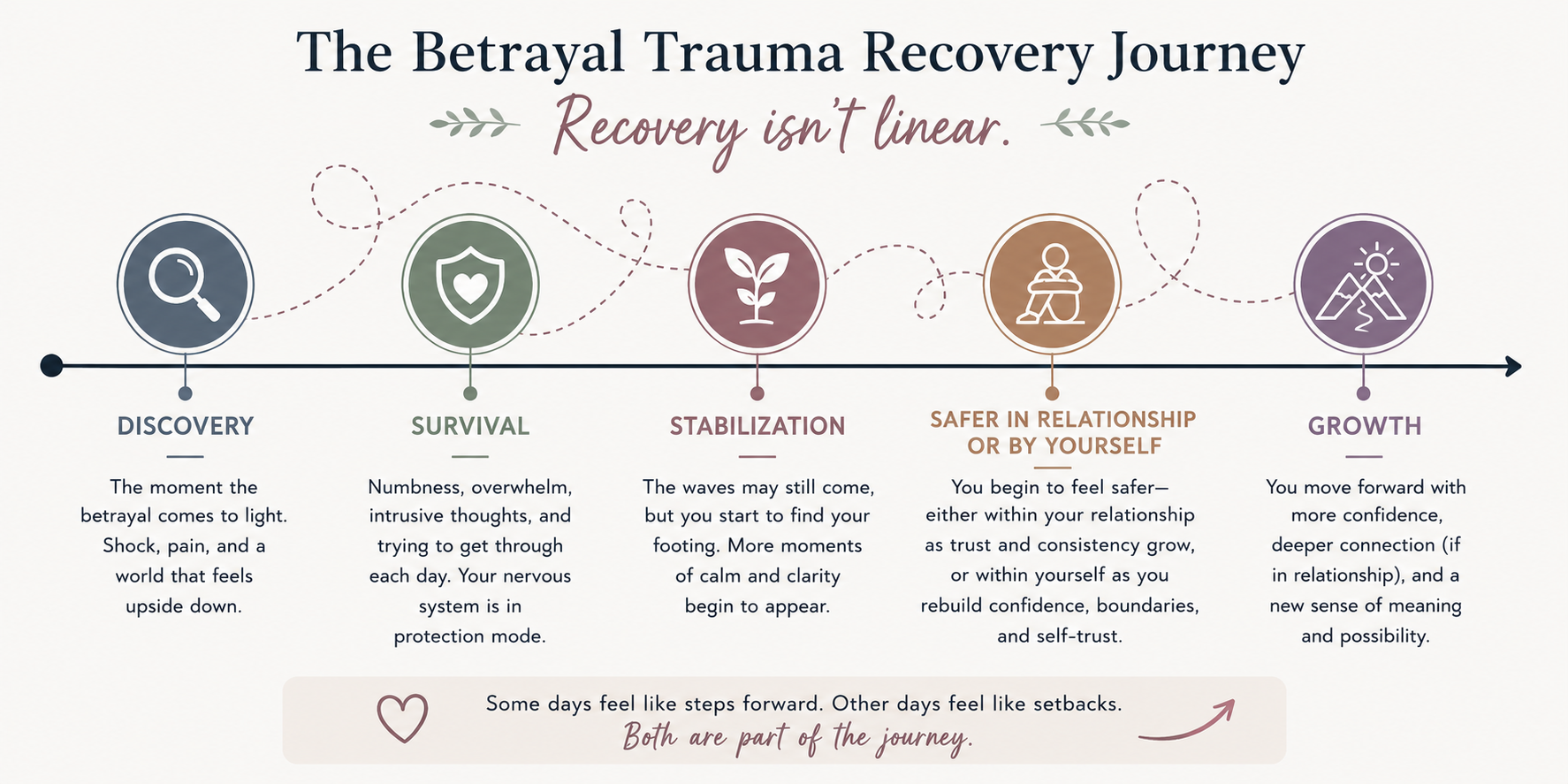
Research and clinical experience consistently suggest that recovery often takes much longer than people expect. Many couples therapists discuss recovery in terms of 18 to 24 months, and sometimes longer, particularly after significant deception or repeated betrayals.
That doesn't mean you'll feel the way you do today for two years.
It means healing is usually gradual rather than linear.
Many people notice meaningful improvement well before then- while still having difficult days or triggers.
Why Does It Take So Long?
People often assume they're healing slowly because they're "too emotional."
In reality, several factors make betrayal especially difficult to recover from.
Your Brain Is Trying to Make Sense of Conflicting Realities
Before discovery, you believed one version of your relationship.
After discovery, you're suddenly trying to reconcile two realities:
"I trusted you."
"You were hiding something significant."
Your mind naturally searches for information that helps those realities fit together.
This is one reason people often ask the same questions repeatedly. They're not necessarily looking for new information- they're trying to create a coherent story that their nervous system can understand.
Trust Doesn't Return Because Someone Says "I'm Sorry"
Apologies matter. Accountability matters. Transparency matters.
But trust isn't rebuilt because someone promises things will be different.
Trust grows through repeated experiences of predictability, honesty, emotional responsiveness, and consistency over time.
Your nervous system is watching for patterns, not promises.
Triggers Are Normal
You may think you're doing better, only to suddenly feel overwhelmed by:
A song
A restaurant
A text notification
A business trip
A holiday
A date on the calendar
A location
A social media post
This doesn't mean you've gone backward.
Triggers often become less intense and less frequent over time as your nervous system begins learning that you're safer than you were on discovery day.
What Affects How Long Recovery Takes?
Every relationship is different, but several factors can influence recovery.
The Nature of the Betrayal
Recovery may take longer when there has been:
Long-term deception
Multiple affairs
Trickle truth
Gaslighting
Financial deception
Repeated broken promises
Multiple discoveries ("D-Days")
The greater the disruption to trust, the more time your nervous system may need to rebuild a sense of safety.
The Response of the Partner Who Strayed In the Relationship
One of the strongest predictors of healing is often what happens after discovery.
Recovery is generally supported when the partner who had the affair becomes increasingly:
Honest
Transparent
Accountable
Emotionally available
Willing to answer questions thoughtfully
Consistent over time
Healing often becomes more difficult when there is continued deception, defensiveness, minimization, blame shifting, or ongoing secrecy.
Your Own History
Current betrayal doesn't happen in a vacuum.
People with previous experiences of betrayal, attachment injuries, childhood trauma, or significant relationship losses may experience a more intense nervous system response.
That doesn't mean healing is impossible.
It simply means your nervous system may have more than one injury it's trying to protect.
Signs You're Healing

Many people assume healing means never thinking about the affair again.
That's not often how recovery works.
Instead, you might notice:
You're sleeping a little better.
The affair isn't the first thing you think about every morning.
Intrusive thoughts happen less often.
Triggers don't last as long.
You're able to enjoy moments of your life again.
Conversations become more productive instead of explosive.
You feel more grounded after difficult moments.
You begin trusting yourself again.
Progress is often measured in small changes that accumulate over time.
What If I Still Feel Terrible Months Later?
Many people worry they're failing because they're still struggling months after discovery.
In many cases, they're not.
Ask yourself instead:
Has new information continued to emerge?
Is there still ongoing dishonesty?
Is your partner becoming safer over time?
Are you receiving support?
Have you had space to process what happened?
Healing is much harder when the injury keeps happening.
Can Therapy Help?
For many couples and individuals, therapy provides a structured place to slow down what often feels overwhelming.
Rather than focusing only on whether the relationship survives, therapy can help people:
Understand how the betrayal developed
Process the trauma response
Rebuild emotional safety
Improve communication
Re-establish trust through consistent behavior
Help process so you can decide whether repair is possible
Approaches such as Emotionally Focused Therapy (EFT) and the Gottman Method are commonly used to help couples navigate affair recovery by addressing both the emotional injury and the relationship patterns that now need attention.
The Bottom Line
There is no deadline for healing from betrayal.
Your nervous system isn't trying to punish you. It's trying to protect you.
Recovery isn't about forcing yourself to stop hurting. It's about gradually creating enough safety, within yourself, your relationship, or both, that your mind no longer has to stay on constant alert.
If you're still struggling, it doesn't automatically mean you're doing something wrong.
It may simply mean your nervous system is asking for more time, more consistency, and more support.
Want Help Navigating Betrayal Recovery?
Healing after an affair can feel confusing and overwhelming, especially when you're trying to make sense of intrusive thoughts, shifting emotions, and uncertainty about the future of your relationship.
If you're looking for practical guidance, explore my therapist-created resources designed to help individuals and couples understand betrayal, rebuild trust, and have the conversations that support healing.
If you're in California or Washington and would like additional support, I also provide couples therapy focused on betrayal recovery, emotional affairs, trust rebuilding, and relationship repair.
I also regularly share educational content about betrayal recovery, trust, emotional affairs, and relationship repair on TikTok. If you're looking for practical insights, you're welcome to follow along there as well.
This article is for educational purposes only and is not a substitute for therapy or individualized mental health care. The information may not apply to every relationship or situation. If your relationship involves coercive control, abuse, or concerns about your immediate safety, seek support from a qualified professional or local resources.